
SYSTÈME D'INFORMATION GÉOGRAPHIQUE PHOTOVOLTAÏQUE

Veuillez confirmer certaines informations de votre profil avant de continuer.
Êtes-vous sûr de vouloir vous déconnecter ?

Vérifiez votre e-mail
Nous avons envoyé un code de vérification à
Vous n'avez pas reçu le code ? Renvoyer
Termes et conditions
Un mail de validation vient de vous être envoyé à :
Merci de cliquer sur le lien pour confirmer votre inscription.
Calculate Your Solar Panel Output with Precision
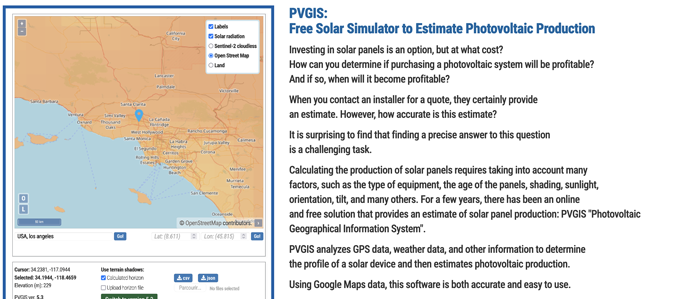
Solar energy represents a sustainable and cost-effective solution for modern energy needs. Before investing in a photovoltaic project, understanding its potential is crucial. The PVGIS solar calculator provides an accurate simulation of your future installation's production capacity at no cost.
This innovative tool delivers realistic and detailed forecasts based on precise, continuously updated data. Whether you're a homeowner evaluating your roof's solar potential or a professional planning large-scale projects, this calculator addresses your specific requirements.
Accurate Data Without the Price Tag
Access to this solar calculator remains completely free while maintaining exceptional accuracy. The tool utilizes reliable information including local climate data, average sunlight exposure, and geographical characteristics to provide comprehensive estimates of expected annual production. These forecasts help you understand your solar panels' potential efficiency and anticipate energy bill savings.
The user-friendly interface makes the calculator accessible to beginners and experts alike. In just a few steps, enter basic information such as your site location, panel orientation, and tilt angle. The tool instantly generates personalized results, enabling informed decisions for your project.
Compare and Optimize Your Solar Setup
This calculator serves as a valuable asset for comparing different photovoltaic installation scenarios. Test the impact of various modifications, such as selecting different panels or adjusting their tilt, to maximize your solar production potential.
For more comprehensive project analysis, explore the solar financial simulator to understand the economic aspects of your investment.
By providing access to high-performance tools at no cost, PVGIS enables everyone to explore solar energy benefits transparently and precisely. This commitment-free simulation offers reliable insights to bring your energy transition goals to life.
Ready to discover your site's energy potential? Try the PVGIS solar panel calculator today and unlock your solar possibilities in just a few clicks!
Frequently Asked Questions
How accurate are PVGIS solar calculations?
PVGIS uses satellite data and meteorological information from multiple sources, providing accuracy typically within 5-10% of actual production values. The system incorporates real weather patterns, seasonal variations, and location-specific solar irradiance data.
What information do I need to use the solar calculator?
You'll need your exact location (address or coordinates), roof orientation (south, east, west), tilt angle of your panels, and the type/power rating of your solar panels. The calculator can also account for shading factors and system losses.
Can I calculate solar potential for commercial installations?
Yes, the PVGIS calculator works for both residential and commercial projects. For large-scale installations, you may want to explore the subscription options for advanced features and bulk calculations.
Does the calculator account for seasonal variations?
Absolutely. The tool provides month-by-month breakdowns of expected solar production, showing how output varies throughout the year based on seasonal sun angles and weather patterns.
What's the difference between the solar calculator and financial simulator?
The solar calculator focuses on energy production estimates, while the financial simulator adds economic analysis including payback periods, return on investment, and long-term savings calculations.
Can I save and share my solar calculations?
Yes, PVGIS allows you to export your results in PDF format and share them with installers, financial advisors, or family members. This makes it easy to get quotes and make informed decisions.
How often is the weather data updated?
PVGIS continuously updates its database with the latest meteorological information and satellite data to ensure calculations reflect current and historical weather patterns for the most accurate projections.
Does the calculator work worldwide?
PVGIS covers most regions globally, with particularly detailed data for Europe, Africa, and parts of Asia. The coverage area continues to expand as more satellite and ground-based data becomes available.
20 BONNES RAISONS
D’UTILISER LE CALCULATEUR
SOLAIRE PVGIS24
- 1 Comment calculer la rentabilité d’un panneau solaire avec PVGIS ?
- 2 Analysez le rendement de votre installation photovoltaïque avec précision
- 3 Évaluez précisément le rendement de votre installation solaire
- 4 Optimisez votre production solaire grâce à un calculateur de haute précision
- 5 Estimez votre production solaire en ligne avec rapidité et simplicité
- 6 Calculez la Production de vos Panneaux Solaires avec Précision
- 7 Maximisez la performance de vos panneaux solaires grâce à PVGIS
-
8 Combien de panneaux solaires faut-il
pour votre maison ? Découvrez-le avec PVGIS - 9 Évaluez le potentiel solaire de votre site avec des cartes d'ensoleillement gratuites
- 10 Optimisez la rentabilité de votre projet photovoltaïque avec une analyse financière complète
- 11 Estimez la production solaire de votre maison avec PVGIS
- 12 Simulez la production solaire de votre emplacement avec une précision d'adresse grâce à PVGIS
- 13 Maximisez votre production solaire grâce à l’analyse de l’inclinaison des panneaux
- 14 Simplifiez la gestion de vos projets solaires avec le logiciel PVGIS
- 15 Trouvez le meilleur angle pour vos panneaux solaires avec PVGIS
- 16 Évaluez le potentiel solaire de votre emplacement grâce à des données géographiques détaillées
- 17 Optimisez vos projets avec l’outil PVGIS dédié aux installateurs solaires
- 18 Évaluez la rentabilité de votre installation photovoltaïque avec précision grâce à PVGIS
- 19 Explorez toutes les facettes de votre projet avec le calculateur photovoltaïque avancé de PVGIS